Have you ever heard someone say, “If it sounds too good to be true, it probably isn’t”? I’ve been taught that my whole life, and I’ve said it myself more times than I can count. But there is one place where that wisdom completely falls apart, and that is salvation through Jesus Christ. It does sound too good to be true — that the perfect God of heaven would send his perfect, holy Son to die a perfect death for imperfect sinners like you and me. It sounds too good to be true that I could spend my whole life falling short of God’s perfect standard and still be given a place in his perfect kingdom, all because of what Jesus Christ did two thousand years ago. But the unfolding, uncontested story of Scripture is that this is exactly what God did, and this morning I want you to leave certain of this: it is so good, and it is so true, that it is too good not to believe.
In John chapter 19, Jesus finally meets his ultimate destiny. His purpose for coming into the world was to die on a sinner’s cross to save sinners like you and me. And I thank God that in his sovereignty and perfect wisdom, he chose to give us the account of Jesus’s life not through one person, but through four. We have the blessing of seeing Jesus’s life play out from four different perspectives, and God did not give us four Gospels simply for the sake of redundancy. He gave them to us first to provide four credible testimonies of the events that took place, so that we can know this is not something one man dreamed up and embellished. We can take the four accounts, compare them to each other, and see a full picture of the life of Jesus Christ. But beyond that, each gospel serves a specific purpose in telling us the story of Jesus, and John’s purpose throughout his entire gospel is that you will know for certain that Jesus Christ is the Son of God — and not only that you’ll know it, but that you will believe in him as your Savior.
He reminds us of that purpose right here in the middle of the crucifixion account. In verse 35, John writes, “He that saw it bare record, and his record is true, and he knoweth that he saith true, that ye might believe.” John is saying: I was there. I saw this happen firsthand. The record I’m bearing to you is a true account of what took place, and I’m telling you this so that you will believe on the Lord Jesus Christ. We are doubtful creatures by nature — you can give someone all the evidence in the world, and there is still something in us that wants to question, wants to wonder, wants to doubt. God knows that about us, and so he has given us countless reasons to believe the testimonies recorded in his Word. Throughout his account of the crucifixion, John repeats the phrase “that the Scripture might be fulfilled,” describing something that happened and then referencing the Old Testament scripture it fulfilled. He does this to show us that Jesus perfectly met all the criteria of what the prophets said would happen to the promised Messiah, and by the time we weigh all the evidence together, it leaves us with no room but to believe.
This matters so much today because we are surrounded by voices that want us to believe all kinds of things — about Christianity, about the world, about ourselves. If we don’t have something solid to hold on to, we can be swayed in any direction, and we have to know why we believe what we believe. This morning, I want to show you five ways that Jesus explicitly fulfilled the prophecies of the Messiah in his crucifixion. And when we get to the end, I’m going to give you some statistics that make it impossible to walk away with any doubt.
1. Crucified Among Sinners (John 19:17-22)
We begin in verse 17: “And he, bearing his cross, went forth into a place called the place of a skull, which is called in the Hebrew Golgotha, where they crucified him, and two others with him, on either side one, and Jesus in the midst.” Jesus has been beaten, questioned, tortured, tried, found innocent, and yet still sent to the cross. This is the one who healed the sick, who brought people back to life, who preached a message of salvation and hope and joy and relief through God. The one who did wonderful miracles and was a blessing to everyone who met him — and yet we find him bearing the cross of a criminal, making his way to a hill where he is going to die.
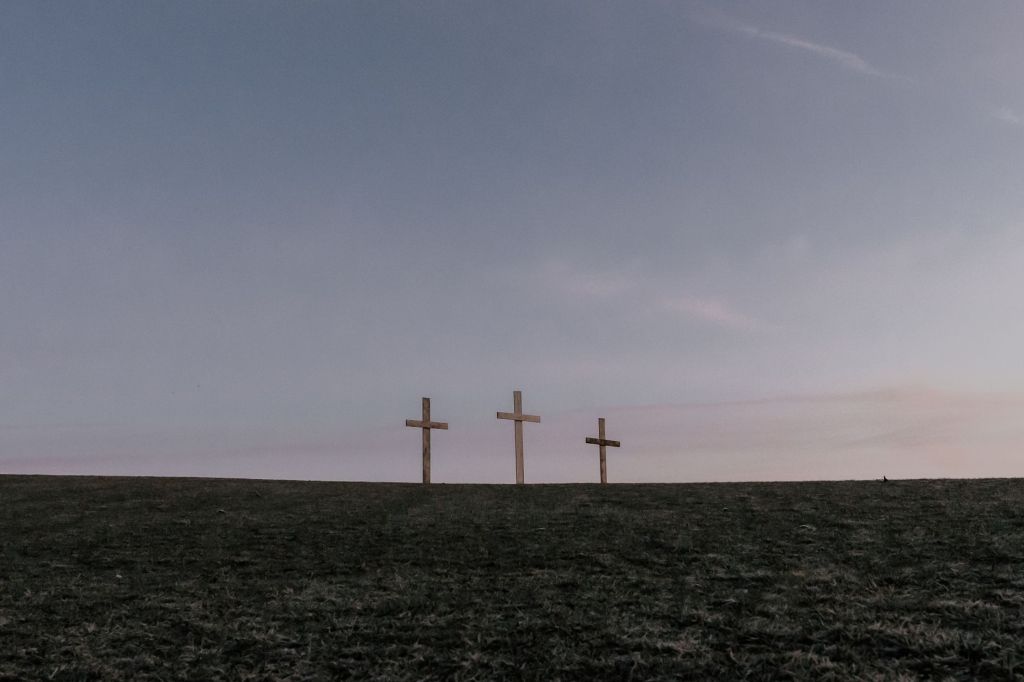
Notice that Jesus did not die alone that day. He hung between two criminals who actually deserved to be there — they did real crimes, and nobody could question their guilt. But the man in the middle hung there surrounded by sinners, condemned for no crime he had committed. They could not find him guilty of anything. He had committed no crime against Rome, no crime against Israel, and yet he died that day surrounded by sinners. This was not an accident. John is pointing us back to Psalm 22:16, a messianic psalm written approximately a thousand years before Jesus walked the earth: “For dogs have compassed me, the assembly of the wicked have enclosed me; they pierced my hands and my feet.” A thousand years before any of these events took place, this psalm promised that God’s anointed one would be crucified, pierced in his hands and his feet, and surrounded by the wicked on every side — and in the scene of the innocent Jesus hanging on the cross, we find the fulfillment of exactly that promise.
2. The Parting of His Robes (John 19:23-24)
Look next at verse 23: “Then the soldiers, when they had crucified Jesus, took his garments and made four parts, to every soldier a part; and also his coat. Now the coat was without seam, woven from the top throughout. They said therefore among themselves, Let us not rend it, but cast lots for it, whose it shall be; that the scripture might be fulfilled, which saith, They parted my raiment among them, and for my vesture they did cast lots.”
Jesus is hanging on the cross, dying for the sins of the world, committing no sin — and the soldiers who crucified him are dividing up his last possessions as prizes. They get to his coat, notice it’s seamless and can’t be torn apart evenly, so they throw dice for it instead. What might seem like a small passing detail is actually striking when you know what Scripture said about the Messiah, because in that very same Psalm 22, verse 18, written a thousand years before Christ, we read: “They part my garments among them and cast lots upon my vesture.” In perfect detail, a millennium in advance, God described what was going to happen to his Son on the cross.
Now a good skeptic might stop right here and say, these scriptures have been around a long time — wouldn’t it be easy to arrange their fulfillment? That’s actually a fair point, and God knew skeptics would make it. But here’s the problem: the ones fulfilling the scripture were completely indifferent to it. These Roman soldiers almost certainly knew nothing about the Jewish scriptures, and they were not setting out that day to make sure they fulfilled some Hebrew book written thousands of years before they were born. They were there to do their job and have a little fun while they did it. These Gentiles, who did not care about Hebrew scripture, perfectly fulfilled in their actions what God said would happen to the Messiah — and that is not coincidence. That is Providence, divine planning that only a perfect and powerful God could orchestrate. And I’ll also remind you that the Jews who were responsible for sending Jesus to the cross did not want him to be the Messiah. If they could have stopped the fulfillment of the scriptures, they would have. But Jesus being crucified by people who didn’t want him to be the Messiah, and by people who didn’t even care whether he was, fulfilled exactly what the Bible said about him. John is showing us this so that we might know: this was no ordinary man.
3. Not a Task Left Undone (John 19:25-27)
Before showing us the final details of the cross, John includes a scene that might seem out of place — but nothing in John’s gospel is accidental. Verse 25-27 tells us: “Now there stood by the cross of Jesus his mother, and his mother’s sister, Mary the wife of Cleophas, and Mary Magdalene. When Jesus therefore saw his mother, and the disciple standing by whom he loved, he saith unto his mother, Woman, behold thy son! Then saith he to the disciple, Behold thy mother! And from that hour that disciple took her unto his own home.”
Why does John include this detail? Because what he is showing us is that before Jesus died, he did not leave a single task undone. He perfectly fulfilled every purpose God gave him when he sent him into the world, and one of those purposes was to perfectly fulfill the ceremonial, civic, and moral law of Old Testament Israel. Under that law, when a father died and left his wife a widow, the oldest son was responsible for her care. Jesus is about to die and then resurrect and ascend to heaven, leaving his mother behind. His earthly brothers, the Bible tells us, were not believers at this point and had questioned Jesus throughout his ministry, so when it came time to transfer that responsibility, Jesus chose the disciple most faithful to him and made sure his mother was provided for according to the law of Moses. John includes this so that we understand Jesus died leaving nothing undone — every task, every responsibility, every jot and tittle of the law was perfectly fulfilled in the way that Jesus lived and died. There is only one person who could do that perfectly, and that is the anointed Messiah, the Son of God.
4. Vinegar to Drink, and “It Is Finished” (John 19:28-30)
Verse 28 says: “After this, Jesus, knowing that all things were now accomplished, that the scripture might be fulfilled, saith, I thirst. Now there was set a vessel full of vinegar; and they filled a sponge with vinegar, and put it upon hyssop, and put it to his mouth. When Jesus therefore had received the vinegar, he said, It is finished: and he bowed his head, and gave up the ghost.”
John tells us that Jesus said “I thirst” specifically so that the Scripture might be fulfilled. Psalm 69:21, written centuries before the cross, says, “They gave me also gall for my meat; and in my thirst they gave me vinegar to drink.” Jesus had no control over what was placed next to the cross — all he had to do was do his part and cry out that he was thirsty, and here they came with a sponge full of vinegar, exactly what the Messiah was promised to receive. It’s also worth noting that the sponge was placed on hyssop, the very branch used in Old Testament cleansing rituals, because every detail in this moment is a thread in the tapestry God had been weaving for centuries. When the vinegar touched his lips, everything was accomplished, and he bowed his head and gave up the ghost — on his own terms, in his own time.
5. Bones Unbroken, Side Pierced (John 19:31-37)
Roman crucifixion was designed to be a long, slow, agonizing death. The position of the body pressed on the lungs so that the victim slowly asphyxiated, and those being crucified would push themselves up on the nails just to gasp for air before collapsing again in exhaustion — and this could go on for a very long time. To speed things up, soldiers would come along and break the legs of those on the cross, taking away their ability to push themselves up and hastening death. The Jews were in a hurry to get these men off the cross before their holy day began, so Pilate sent soldiers to do exactly that. They broke the first man’s legs, then the second man’s — but when they came to Jesus, they found he was already dead. So one soldier drove a spear into his side, and blood and water came out, confirming it.
In doing both of these things, those same indifferent Roman soldiers once again fulfilled the prophecies of the Messiah. Psalm 34:20 says, “He keepeth all his bones; not one of them is broken.” And it is worth noting that when God gave Israel instructions for the Passover lamb, it was essential that they break no bone in the lamb’s body — because Jesus was going to be the ultimate Passover lamb, and not a single one of his bones would be broken. And Zechariah 12:10, written centuries before the cross, says, “And they shall look upon me whom they have pierced.” Every detail of the cross — down to the split-second decisions soldiers made in the final moments — fulfilled the prophecies of the Messiah.
The Math Makes It Impossible
John goes through these painstaking details for one reason: to show us there is no possibility we have the wrong guy, no possibility that Jesus is not the promised Messiah. But if the Scripture alone is not enough to settle it for you, let me give you something extra, because I love a good statistic. I wanted to know what the statistical probability was that a random person could have fulfilled all these prophecies the way they were fulfilled, and the numbers are staggering — the probability of these prophecies being fulfilled by accident is approximately one in ten trillion. Let me help you feel the weight of that. It is more likely that you will win the lottery thirty-four thousand times than it is that a man would accidentally fulfill all the prophecies Jesus fulfilled — and those statistics are based only on what he fulfilled in dying on the cross, not the hundreds of other fulfillments throughout his lifetime.
What does that mean? It means it is a statistical impossibility that Jesus is not the Messiah. Math tells us Jesus is the Messiah. History tells us Jesus is the Messiah. Scripture tells us Jesus is the Messiah. You can study him from any angle you choose, and all the evidence arrives at the same conclusion. He was not a random man, and these were not random accidents that somehow came together. This is the Son of God, the perfect Lamb, dying on the cross for the sins of the world — and you cannot refute it.
What This Means for You
He is who he says he is. He did what he promised he would do. And that matters to you and me today, because it means everything he promised us is real — that you really can have forgiveness from your sins, that you really can know the God of heaven personally, that you really can have everlasting life. If you believe on him, you are welcomed into the kingdom of God, with heavenly riches beyond your ability to fully understand, and you don’t have to doubt a single word the Bible says, because everything it has promised is true. It is impossible for it not to be.
If you came here today with any doubt about your faith, about what’s available to you through Jesus Christ, about whether God loves you or is with you, about whether you can go to heaven one day — let this be your answer. There is nothing to doubt, nothing to fear, nothing to dread. The perfect Son of God died for you and said, “Come unto me, all ye who are weary and heavy laden, and I will give you rest.” The invitation today is to rest in Jesus Christ, because he is the Son of God, because he is the promised Messiah, and the blessings of an Almighty God are available to you right now because he paid your price and invited you to trust in him. Don’t leave with doubt in your heart today — leave with confidence, leave with joy, because Jesus loves you and invites you to know him.

Leave a comment